
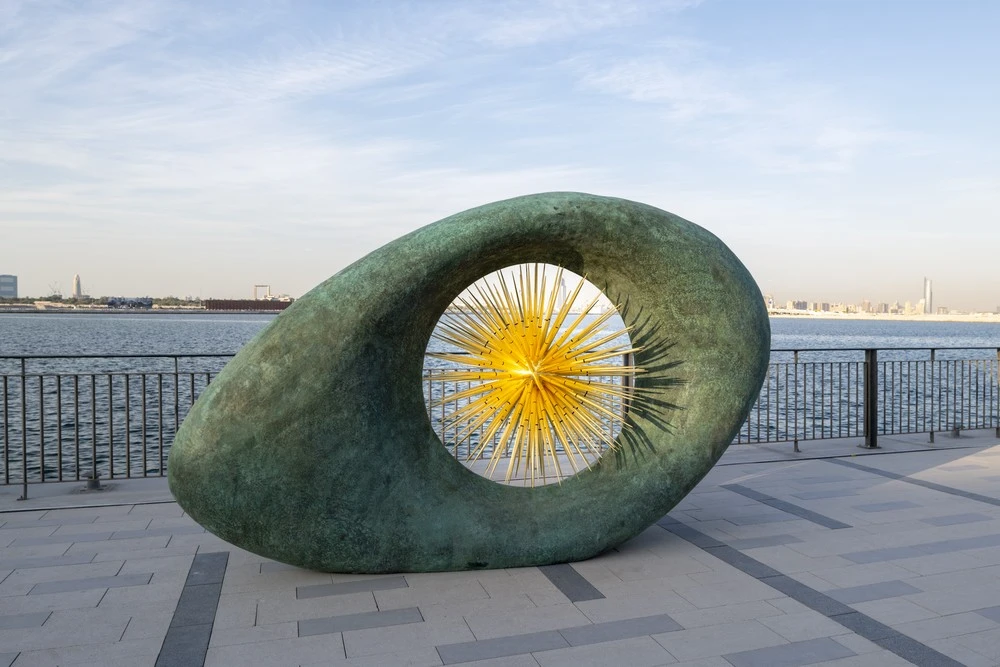
There is a large-scale public sculpture in your city, or close to it — the kind that gets photographed, that crowds gather around, that becomes, over time, a piece of how a neighborhood or institution describes itself. What you likely don’t know, standing in front of it, is that the material it is made from was developed for aircraft fuselages, racing cars, and spacecraft components. That the engineers who solved its structural problems came from an industry that measures weight savings in grams per square meter because every gram costs fuel. And that the fabrication techniques used to give it that seamless, apparently gravity-defying form were originally refined to build parts that had to survive traveling at several hundred miles per hour.
The migration of aerospace materials and manufacturing methods into public art and architectural installation is one of the more quietly transformative stories in contemporary design. It has not happened because artists suddenly became interested in aerospace technology. It has happened because the forms that artists and architects now want to create cannot be built any other way.
Why traditional materials have a ceiling.
For most of architectural and sculptural history, ambition was bounded by material properties. Stone could be carved but not bent. Steel could be shaped but added weight that required its own structural solutions. Concrete could be formed but demanded formwork and curing time that made complex curves enormously expensive. Wood offered warmth and workability but limited lifespan outdoors. Each material had a zone of achievability — a set of forms and scales that it handled well — and design operated substantially within those zones.
The constraint wasn’t failure of imagination. It was the physical reality that traditional materials impose their own geometry. Stone likes to be a column or a wall. Steel likes to be a beam or a frame. The organic, compound-curved, apparently weightless forms that appear in contemporary architectural installation don’t have natural equivalents in the vocabulary of traditional building materials. Creating them in stone or conventional steel is either impossible at scale or prohibitively expensive.
What fiberglass and carbon fiber changed.
Composite materials — primarily fiberglass-reinforced polymer and carbon fiber-reinforced polymer — don’t have these geometric constraints. They are formed rather than carved or bent. The process begins with a mold, which can be shaped to any geometry that can be designed and machined, and the composite material is applied to that mold surface and cured into a self-supporting structure. The resulting form can be concave, convex, twisting, undercut, or multiply curved — any geometry that was achievable in the mold is achievable in the finished piece.
More significantly, composites deliver structural performance at a fraction of the weight of equivalent metal forms. Carbon fiber specifically achieves tensile strength that exceeds steel while weighing roughly a quarter as much. For large-scale outdoor installations — where wind loading, seismic requirements, and the physics of hanging or cantilevering enormous surfaces create serious engineering challenges — this weight advantage is not merely convenient. It is often the enabling condition for a design to be buildable at all.
The engineering problem hiding inside every organic form.
This is where the aerospace connection becomes most direct. The structural engineering of a complex composite form — one that must carry its own weight, handle dynamic loads from wind, survive thermal cycling through extreme seasonal temperature variation, and remain dimensionally stable over decades of outdoor exposure — is not conceptually different from the engineering of a composite aircraft component. The same calculations that determine whether a carbon fiber wing spar will survive flutter and fatigue also determine whether a composite sculpture will survive a thirty-year installation in an exposed plaza.
The tools that aerospace engineers developed to model, analyze, and optimize composite structures — finite element analysis, layup optimization, failure mode prediction — are the same tools that now allow fabricators to design the internal structure of architectural installations with confidence. The fact that the final product will be looked at rather than flown doesn’t change the underlying physics of what the material needs to do.
Composite fabrication at the intersection of art and architecture demands exactly this dual fluency — the ability to interpret a designer’s formal vision and translate it into an engineered object whose surface and structure are inseparable, whose aesthetic refinement and structural integrity are achieved simultaneously through the same material system and manufacturing process.
The mold as the crucial intermediate object.
Between a designer’s intent and a finished composite installation lies an object that most observers of the final work never think about: the mold. The mold is where geometric precision is established. It must faithfully represent the designed surface at the scale of the finished piece, with tolerances tight enough that the composite surface laid over it will hold the intended form without distortion. For large sculptures and architectural elements — pieces that may span several meters in any dimension — this means the mold itself is a precision engineering challenge, often machined on 5-axis CNC equipment capable of cutting complex three-dimensional surfaces to within fractions of a millimeter.
The investment in mold quality is what determines whether the finished piece achieves the standard of surface quality that architectural and artistic applications demand. An aerospace component can carry surface imperfections that would be invisible in service. A public sculpture is examined at close range, in raking light, by people who have every opportunity to notice inconsistencies in surface texture, waviness in a supposedly smooth transition, or mismatch between adjacent panels. The precision tolerance that the aerospace industry developed for structural reasons turns out to be equally necessary in art for purely visual ones.
What the convergence makes possible.
The practical outcome of these converging capabilities is a design space that simply didn’t exist at any accessible cost point twenty years ago. Architects can now specify facades with compound curvature that would previously have required stone carving at prohibitive expense. Artists can realize monumental outdoor sculptures in forms that no traditional material or process could have achieved. Institutions commissioning public art can get pieces that are both visually extraordinary and engineered to last for generations outdoors without the maintenance demands of painted steel or the fragility of stone.
None of this is visible from the outside of the finished work. What visitors see is a form that appears inevitable — as if it could only have been that shape, made from something that has no obvious seams or substrate. What made that apparent inevitability possible is the same engineering tradition that keeps aircraft in the sky.
