
The digital landscape of 2026 has shifted dramatically. With generative tools becoming a staple in every classroom and office, many students mistakenly believe that the art of writing is becoming obsolete. However, the reality is exactly the opposite. As automated content saturates the internet, the ability to communicate with human nuance, emotional intelligence, and structural precision has become the ultimate competitive advantage. For undergraduate students entering a global workforce, English composition is no longer just about passing a class; it is about mastering the primary tool of influence.
Understanding the mechanics of a persuasive argument or a clear narrative is essential for academic success. When students face complex modules, many turn to a professional assignment writing service to ensure their ideas are articulated correctly and follow strict university guidelines. This is because writing is not just a way to record thoughts—it is a way to refine them. Mastering the structure of an essay early on allows students to perform better in high-level research projects later in their careers.
The Evolution of Literacy in a Digital Age
In the past, literacy was defined by the ability to read and write. Today, it has evolved into “rhetorical agility.” This means knowing how to adjust your tone for different audiences, whether you are writing a technical report for a manager in London or a creative pitch for a startup in Singapore. Automation can generate facts, but it struggles to build the bridge of trust between a writer and a reader.
The global economy currently values “Information Gain.” This concept refers to providing insights that haven’t been repeated a thousand times elsewhere. Human writers can draw from personal experience, cultural context, and current events in ways that software cannot. For a student, mastering English composition means learning how to stand out in a world where everyone else is hitting “generate.”
Why Structure Outperforms Vocabulary
Many students think that “good writing” means using big words. In reality, the best writing is characterized by its structure. A well-organized essay guides the reader through a logical journey. If the structure is weak, the most sophisticated vocabulary in the world won’t save the argument.
| Feature | Automated Writing | Human Composition |
| Tone | Often repetitive or “gray” | Dynamic and emotionally resonant |
| Context | Limited to training data | Real-time and culturally aware |
| Logic | Predictable patterns | Creative leaps and unique analogies |
| Purpose | Information delivery | Persuasion and connection |
By focusing on how one idea flows into the next, you develop a “mental map” that is applicable to any career, from engineering to law. Writing teaches you how to think, and thinking is the one thing we cannot outsource.
Bridging the Language Gap for Global Students
For many international students, the challenge isn’t just about the ideas themselves, but about translating those ideas into the formal expectations of Western academia. This is where specialized training becomes invaluable. Navigating the nuances of syntax and tone often requires specific English assignment help through MyAssignmentHelp to ensure that the student’s unique voice isn’t lost in translation. Mastering these nuances allows a student to participate in the global academic conversation with confidence.
Writing in a global tone requires an understanding of “plain English.” This doesn’t mean “simple” English; it means clear, direct communication that avoids local slang that might confuse a reader from a different background. As companies become more decentralized, the person who can write a clear, unambiguous email or proposal becomes the most valuable person in the room.
Critical Thinking: The Silent Partner of Writing
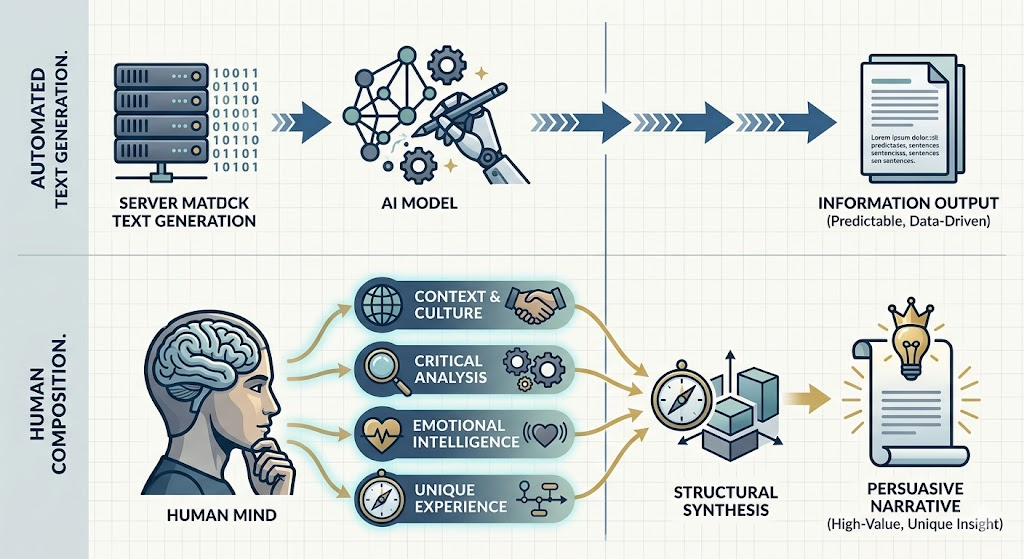
Every time you sit down to write an essay, you are performing a series of high-level cognitive tasks. You are evaluating sources, identifying biases, and synthesizing different viewpoints into a single conclusion. This process is the core of critical thinking.
Automation often hallucinates facts or provides “safe,” middle-of-the-road answers. A skilled writer, however, can take a stance. They can look at a set of data and say, “This is what this means for our future.” This level of interpretation is what employers are looking for. They don’t want someone who can just summarize a meeting; they want someone who can write a summary that highlights the most important action items and potential risks.
Enhancing Dwell Time through Narrative
In the world of search engine optimization (SEO), “dwell time” is a metric that measures how long someone stays on a page. In the world of human communication, it’s called “engagement.” If you write a boring, robotic essay, your professor (or your future boss) will skim it. If you write with a human pulse, they will read every word.
To improve engagement, students should use:
- Analogies: Compare complex ideas to everyday objects.
- Varied Sentence Length: Use short sentences for impact and longer ones for detail.
- Active Voice: Instead of saying “The experiment was conducted,” say “We conducted the experiment.”
The Sustainability of Human Expertise
As we look toward the 2030s, the “premium” on human-produced content will only grow. We are already seeing a “dead internet” theory where bots talk to bots. In this environment, a handwritten letter, a deeply researched article, or a thoughtfully composed essay becomes a luxury good.
Students who invest time in their writing skills now are essentially “future-proofing” their careers. Whether you end up working in AI development or healthcare, you will always need to explain your value to others. Writing is the most efficient way to scale your expertise.
Final Thoughts for the Undergraduate Journey
University is the best time to fail and iterate with your writing. Don’t be afraid of the blank page. View every assignment as an opportunity to sharpen your “persuasion muscles.” The goal isn’t to be perfect; the goal is to be clear, honest, and helpful to your reader. When you write with the intent to help someone else understand a concept, you naturally become a better writer.
Frequently Asked Questions (FAQ)
Q1: Can I use AI to help me outline my essays?
Ans: Using technology for brainstorming is common, but the final composition must be yours. The “Information Gain” that helps you rank on Google and impress professors comes from your unique perspective and “Human-in-the-Loop” editing.
Q2: How long should a high-quality academic blog post be?
Ans: For the best visibility and depth, aim for 1,200 to 1,400 words. This length allows you to cover the topic thoroughly without creating “thin content” that search engines ignore.
Q3: What is a “global tone” in writing?
Ans: A global tone is professional, inclusive, and avoids regional idioms. It focuses on clarity so that a reader in Sydney can understand it just as easily as a reader in New York.
Q4: Why is “active voice” better for engagement?
Ans: Active voice identifies the “doer” of the action immediately. It makes the writing feel more direct and energetic, which keeps the reader’s attention longer.
Q5: How can I improve my English composition if it’s my second language?
Ans: Read widely in your field of study, practice writing daily, and don’t hesitate to seek out academic support services to help you understand the specific formatting and tonal requirements of your university.
About The Author
I am Ruby Walker, a Senior Academic Consultant at MyAssignmentHelp with over a decade of experience in content strategy and educational mentoring. My work focuses on bridging the gap between complex academic requirements and clear, impactful communication.
