
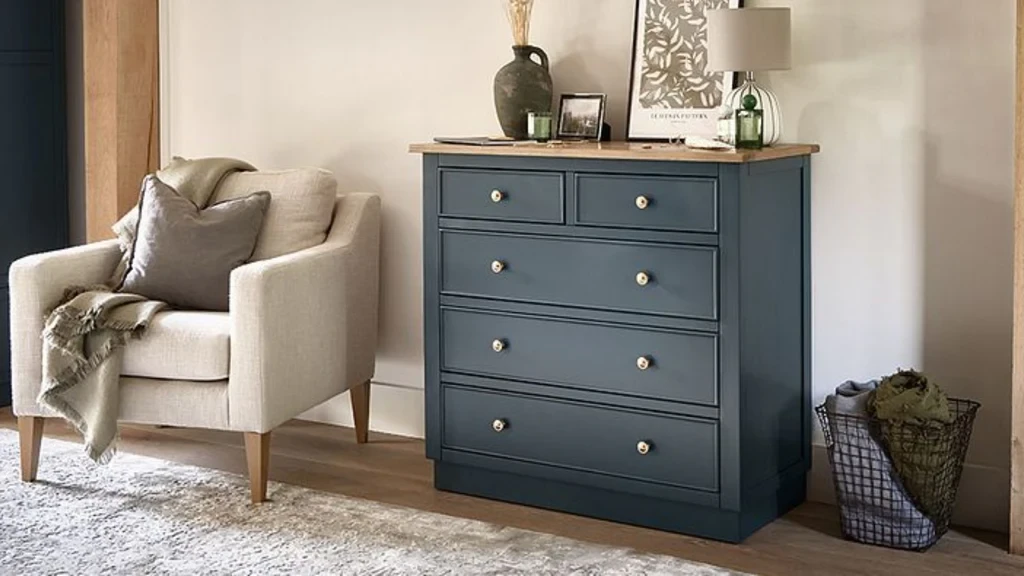
There is a piece of furniture in almost every bedroom in America that receives almost no admiration, very little maintenance, and surprisingly little thought when a room is being redesigned. It holds a significant portion of everything you wear. You open it before you’re fully awake in the morning and close it when you’re half asleep at night. It has been a staple of domestic life for centuries, quietly doing its job with zero complaint. And yet, when most people talk about redecorating a bedroom, the chest of drawers comes up last — if it comes up at all.
It deserves considerably more credit than it gets.
A brief history of an object that changed how people lived.
Before the development of the chest of drawers in the seventeenth century, clothing storage was primarily managed through large flat-lidded trunks and armoires. Access was inconvenient — retrieving anything required lifting a heavy lid or opening wide doors to rummage through piled fabric. The introduction of sliding horizontal drawers stacked in a vertical case was, in the context of domestic storage, a genuine innovation. It transformed the act of getting dressed from an archaeological excavation into an organized, efficient process.
The basic form has remained largely unchanged for over three hundred years. Not because no one has tried to improve on it, but because the design is close to optimal for what it does. Horizontal drawers, accessed from the front, stacked vertically in a case with a flat top surface — this configuration organizes folded clothing efficiently, keeps items visible and accessible, and provides a useful working surface at the top for lamps, mirrors, and everyday objects. The fact that the chest of drawers looks almost identical today to how it looked in an eighteenth-century household speaks to how well the original design worked.
Why it’s the hardest-working piece in the room.
Consider what the average chest of drawers actually does in a household. It organizes and stores clothing for one or more people, typically separating categories — shirts, underwear, socks, sweaters — into discrete compartments that prevent the chaos that would otherwise accumulate in a shared space. It provides a stable surface at standing height for items that need to be accessible without being stored — keys, watches, chargers, books. In smaller bedrooms, it often substitutes partially or entirely for a closet. In homes shared by couples, it quietly mediates what would otherwise be a perpetual domestic negotiation about space.
It does all of this without requiring power, without needing software updates, without breaking down in ways that make the evening news. The mechanism is simple: a wooden box that slides within a wooden frame, held by gravity and friction. When built well, this mechanism works smoothly for generations. When built poorly, it sticks, warps, and frustrates in ways that accumulate into a slow, low-level daily irritation.
The quality gap that most people don’t notice until it’s too late.
Here is where the chest of drawers is most underappreciated: the difference between a well-made one and a poorly made one is enormous, but it is not always obvious at the point of purchase. A flat-pack chest assembled with particle board and thin veneer can look presentable in a showroom or a product photograph. It is only after a year or two of daily use that the drawer bottoms begin to sag, the joints start to loosen, and the smooth glide that seemed fine when new begins to drag and bind.
A chest built from solid wood, with properly fitted drawer boxes, quality hardware, and joinery that was designed to last — dovetailed corners, dust panels between drawers, a sturdy case construction — behaves differently. The drawers open and close with consistent smoothness twenty years after installation. The structure doesn’t rack or wobble. The finish ages rather than peeling. And crucially, the piece can be refinished, repaired, and passed on, rather than ending up in a landfill when a veneer corner chips or a drawer slide fails.
This is the logic behind seeking out quality bedroom chests for sale from furniture retailers who carry pieces built to last rather than pieces built to a price point — the long-term cost of a well-made chest is almost always lower than the repeated replacement cost of cheap ones, and the daily experience of using it is meaningfully better throughout.
What it contributes to a room that nothing else can.
Interior designers who work on bedroom spaces often describe a room with good storage as one that breathes — where the visual field isn’t cluttered by overflow, where surfaces can be intentionally curated rather than buried under the things that have no home. A chest of drawers that provides genuinely useful, well-organized storage changes the energy of a bedroom in ways that a new duvet cover or a fresh coat of paint simply cannot.
When the chest is also well-proportioned, made from quality materials, and designed with some aesthetic intention, it becomes a visual anchor — a piece that grounds the room and gives it a sense of solidity and permanence that flat-pack furniture rarely achieves regardless of style.
None of this is glamorous. The chest of drawers will never be the statement piece that a dramatic headboard or an unusual pendant light is. But it is, in daily life, the piece you rely on most — and the one most worth getting right.
